What is 3D Printing?
3D printing, also called additive manufacturing, builds a physical object layer by layer directly from a digital CAD file. Instead of cutting away material (like machining) or forcing material into a mold (like injection molding), a 3D printer adds material only where it’s needed — one thin layer at a time — until the part is complete.
This “additive” approach is what makes 3D printing fundamentally different from traditional manufacturing: no tooling, no molds, minimal material waste, and the ability to produce complex geometries that would be impossible — or extremely expensive — to machine conventionally.
Why 3D Printing is Needed
For engineering and product teams in Chennai and Bangalore, 3D printing solves problems that traditional manufacturing simply isn’t built for:
| Business Need | How 3D Printing Solves It |
|---|---|
| Faster design validation | Physical prototypes in hours/days instead of weeks |
| No tooling investment | Skip expensive molds for low-volume parts |
| Complex geometries | Internal channels, lattices, organic shapes — no extra cost |
| Design iteration | Test, modify, reprint — without re-tooling |
| Bridge production | Produce functional parts while injection tooling is being built |
| Reverse-engineered parts | Convert scanned/CAD data directly into a physical test part |
Types of 3D Printing & Their Outcomes
Process Comparison
| Technology | Process | Best Outcome | Typical Use Case |
|---|---|---|---|
| FDM | Melted filament, extruded layer by layer | Functional, low-cost parts; visible layer lines | Jigs, fixtures, low-stakes prototypes |
| SLA | UV laser/light cures liquid resin | Finest detail, smooth surface finish, near injection-mold quality | Design validation, engineering prototypes, dental/jewelry models |
| SLS | Laser sinters nylon powder | Strong, isotropic parts, no supports needed | Functional, load-bearing, complex geometries |
| MJF | Fusing agent + heat across powder bed | Fast batch production with consistent strength | Short-run functional production parts |
Spotlight: Formlabs Form Series (SLA)
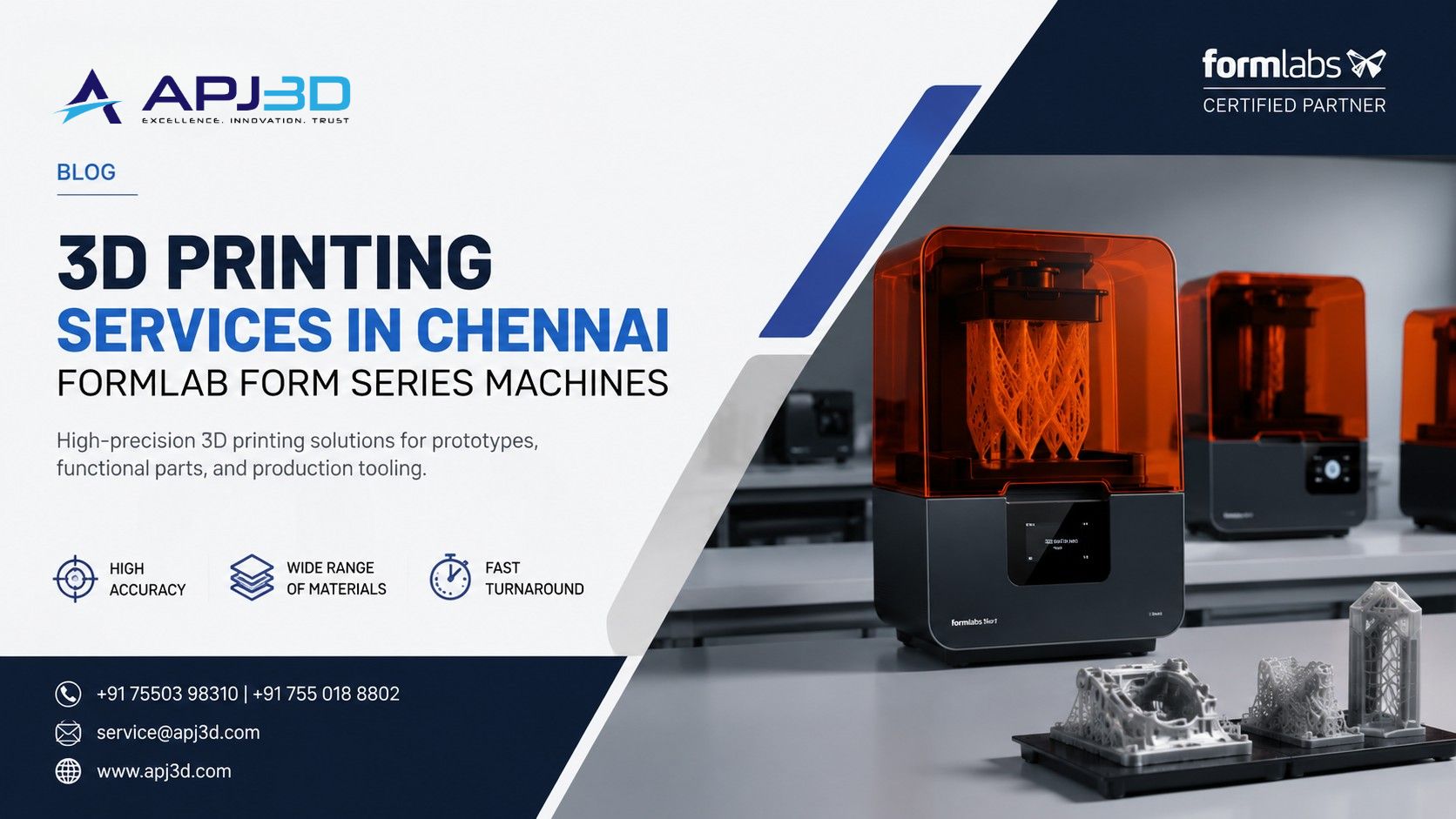
Among SLA machines, the Formlabs Form series (Form 3+/Form 4) is widely regarded as one of the most reliable choices for professional-grade resin printing.
Key Features
Layer Resolution
As fine as 25 microns (0.025mm) — captures fine text, threads, and intricate detail.
Surface Finish
Smooth, near injection-molded finish straight off the printer, with minimal post-processing.
Resin Library
Standard, tough, high-temp, castable, and biocompatible resins for different engineering needs.
Common resin types used in engineering work
Grey Pro, Tough 2000, High Temp, Rigid, and Castable resins — chosen based on the mechanical or visual requirement of the part.
Accuracy
Consistent, repeatable accuracy — ideal for design validation where dimensional tolerance matters.
This makes the Form series particularly well-suited for the kind of precision prototyping work Chennai and Bangalore’s automotive, industrial, and product design teams need.
What Customers Actually Want Most
Across client conversations in this region, the same priorities come up again and again:
| Priority | What It Means in Practice |
|---|---|
| Speed | Same-day or next-day turnaround for small prototypes |
| Accuracy | Tight tolerances that match the original CAD design |
| Surface finish | Parts that look and feel close to the final product |
| Material strength | Parts that can survive functional/fit testing, not just look good |
| Cost transparency | Clear, upfront pricing with no surprise charges |
Market Rate Benchmark (Chennai & Bangalore)
Indicative Pricing by Technology
| Technology | Typical Rate | Unit |
|---|---|---|
| FDM (PLA/ABS) | ₹3 – ₹12 | per gram |
| SLA (Standard Resin) | ₹8 – ₹15 | per gram / ₹30–40 per cm³ |
| SLA (Engineering/Castable Resin) | ₹100+ | per cm³ |
| SLS (Nylon) | ₹10 – ₹20 | per gram |
| Metal (DMLS) | ₹50 – ₹150 | per gram |
Note
Rates vary by part size, geometry, infill/support requirements, and post-processing needs. For an exact quote, share your CAD/STL file with our team.
Typical Turnaround Time (TAT)
| Order Type | Typical TAT |
|---|---|
| Single prototype (small part) | 24 – 48 hours |
| Multiple prototypes / design iteration batch | 2 – 4 days |
| Low-volume production run | 5 – 10 days |
| Complex/large assemblies with finishing | 7 – 14 days |
Note
Actual TAT depends on part complexity, quantity, and finishing requirements.
Why Choose APJ3D for Your 3D Printing Needs
At APJ3D, 3D printing isn’t a standalone service — it’s backed by our full engineering stack: reverse engineering, CAD modeling, 3D scanning, and inspection, all under one roof. That means when you send us a part, we don’t just print it — we can validate geometry, optimize for print, and inspect the final output against your original design specs.
With SLA printing on Formlabs Form series machines, we deliver the fine detail and dimensional accuracy that automotive, industrial, and product design teams across Chennai and Bangalore need for serious design validation — not just rough concept models.
Get in Touch
Ready to get your part printed right the first time?
📞 Call/WhatsApp: +91 75503 98310
📧 Email: [email protected] / [email protected]
Share your CAD/STL file today and get a custom quote for your project.